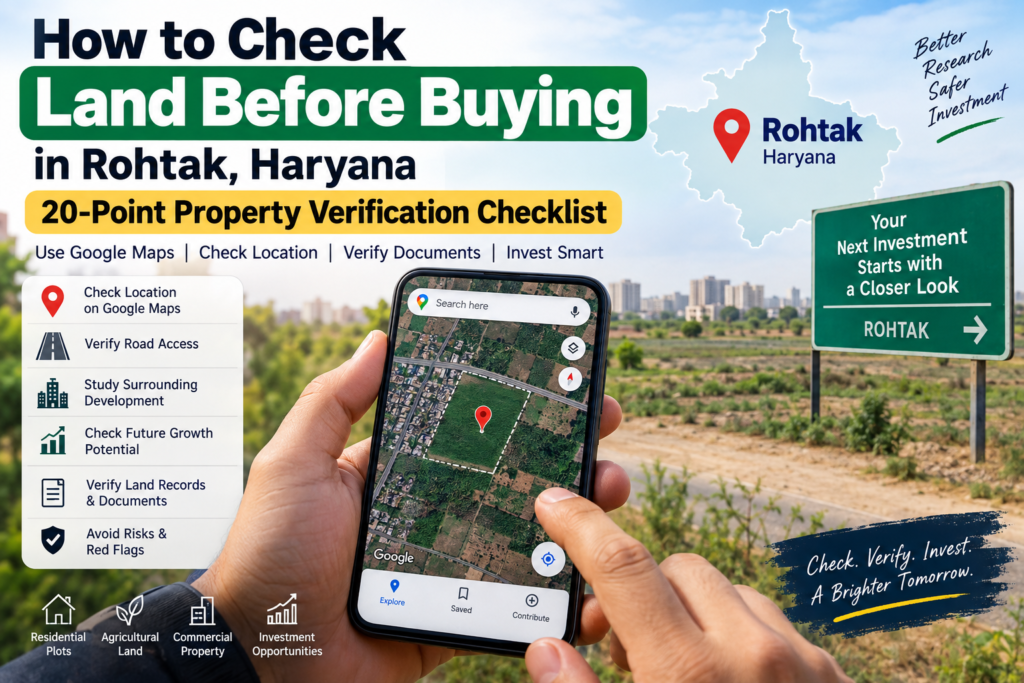
Buying land is one of the biggest investments you can make. Whether you are looking for agricultural land, residential plots, residential land, commercial property or investment land in Rohtak, checking the property properly before making a payment is extremely important.
Many buyers look only at the location, road and price. But a good-looking property is not necessarily a safe property to buy.
In this guide, we explain how to check land before buying, how to use Google Maps and satellite view to check a property, and what documents and legal details you should verify before purchasing land in Rohtak, Haryana.
1. Check the Exact Location of the Property
The first step is to identify the exact location.
Ask the seller or property dealer for:
- Exact Google Maps location
- Khasra number
- Village name
- Total land area
- Property boundaries
- Approach road details
Do not rely only on statements such as:
“This property is near Rohtak bypass.”
“This land is near the highway.”
“The colony is just 500 metres from here.”
Open the location on Google Maps and verify the actual distance yourself.
Why is this important?
Two properties advertised as being in the same area can have completely different locations, road access and development potential.
2. Check the Approach Road
One of the most important things to check before buying land is road connectivity.
Use Google Maps satellite view and check:
Property → Approach Road → Main Road → Highway/Bypass
Check:
- Is there an actual road reaching the property?
- How wide is the road?
- Is the road usable throughout the year?
- Does the road connect to a main road?
- Is access dependent on somebody else’s private land?
- Is the road visible on the ground as well as on satellite imagery?
Important
A road visible on Google Maps does not automatically mean that you have a legal right of way.
Always verify the road/access rights through official records and on-site inspection.
3. Use Google Maps Satellite View Before Visiting
You don’t always need to visit a property immediately.
First, use Google Maps satellite view to perform an initial property screening.
Look around the property for:
- Houses
- Residential colonies
- Roads
- Factories
- Industrial areas
- Schools
- Hospitals
- Markets
- Petrol pumps
- Warehouses
- Commercial buildings
- Agricultural fields
- Drains
- Canals
- Ponds
This can save considerable time when you are comparing multiple properties.
4. Check Development Around the Property
Don’t look only at the land you are buying.
Zoom out approximately 1–3 km and study the surrounding area.
Ask:
Is the area developing?
Look for:
- New houses
- New roads
- New colonies
- Commercial activity
- Industrial development
- Schools and colleges
- Hospitals
- Warehouses
- Petrol pumps
- Other infrastructure
A property surrounded by active development can have a different investment profile from an isolated property surrounded by undeveloped agricultural land.
5. Identify the Direction of City Expansion
This is especially useful when buying land for long-term investment.
Look at the development pattern:
Existing city → developed colonies → new construction → vacant land → your property
If development appears to be moving toward the property, it may be worth investigating further.
However, remember:
Future development is not guaranteed simply because a property is located near existing development.
Always verify proposed roads, projects and land-use changes through reliable official sources.
6. Compare Historical Satellite Images
Another useful property research technique is comparing older satellite imagery with current imagery.
Where historical imagery is available, compare:
Past → Present
Look for:
- New roads
- New houses
- New colonies
- New factories
- Increasing construction
- Changing land-use patterns
- Infrastructure development
If an area has shown consistent development over several years, that provides useful context when evaluating an investment.
7. Check for Waterlogging and Drainage Problems
Before buying land in Haryana, drainage should not be ignored.
Look for:
- Drains
- Canals
- Ponds
- Low-lying areas
- Water channels
- Flood-prone areas
- Agricultural drainage channels
Also inspect the property physically, preferably after rainfall.
A property that looks excellent during dry weather can have serious drainage problems during the monsoon.
8. Check What Is Located Near the Property
Not all development is good development.
Check whether the property is close to:
- Heavy industries
- Sewage drains
- Garbage dumping areas
- Brick kilns
- Railway tracks
- High-tension electricity lines
- Large drainage channels
- Noisy industrial units
- Other undesirable land uses
These factors can affect both property value and future resale demand.
9. Measure Distance to Important Locations
Don’t simply believe statements like:
“Highway is very close.”
Measure the approximate distance yourself.
For every property, record:
| Location | Approximate Distance |
|---|---|
| Main Road | ___ km |
| Highway | ___ km |
| Rohtak City | ___ km |
| Rohtak Bypass | ___ km |
| Railway Station | ___ km |
| Hospital | ___ km |
| School/College | ___ km |
| Market | ___ km |
| Industrial Area | ___ km |
This gives you a much clearer picture when comparing different properties.
10. Check Whether the Property Is Landlocked
A property may look attractive on satellite imagery but still have poor accessibility.
Check:
- Number of roads surrounding the property
- Road width
- Entry/exit points
- Boundary configuration
- Adjacent properties
- Whether the property has independent access
Red flags
Be careful if:
- The property has no direct road
- Access is through a narrow private passage
- The road ends before reaching the property
- The seller cannot clearly explain the access route
11. Check the Shape and Layout of the Land
Land shape can affect usability and future development.
Check whether the property is:
- Rectangular
- Square
- Irregular
- Very narrow
- Deep and narrow
- Divided by a road/drain
- Affected by adjoining properties
For residential or commercial development, a regular-shaped parcel with good road frontage can sometimes be more practical than an irregular parcel of the same area.
12. Verify Ownership Documents
Google Maps cannot tell you whether the person selling the land actually owns it.
Before purchasing, verify the relevant land records and ownership documents.
Depending on the property, check:
- Jamabandi/Fard
- Mutation
- Khasra details
- Khewat/Khatauni
- Previous ownership documents
- Sale deed/title chain
- Encumbrances or loans
- Court disputes
The exact documents and verification process can vary according to the type of property.
13. Check Land Use
One of the most important questions is:
What is the legal use of this land?
For example, don’t assume that agricultural land can automatically be used for:
- Residential plots
- Commercial development
- Warehouses
- Industrial activity
Check the applicable land-use classification, zoning and permissions.
If a seller says:
“This will become a residential colony.”
Ask for documentary evidence rather than relying on a verbal promise.
14. Check Colony Approval and Layout
If you are buying a plot in a colony, ask:
- Is the colony approved?
- Is the layout approved?
- Are roads shown in the approved layout?
- Are public facilities provided?
- What permissions are applicable?
- Does the actual site match the approved plan?
Never assume that a property is legally approved simply because many houses have already been constructed nearby.
15. Check for Acquisition or Infrastructure Issues
Before purchasing land for investment, investigate whether the property could be affected by:
- Proposed roads
- Highway projects
- Government acquisition
- Infrastructure projects
- Development plans
- Restricted zones
- Utility corridors
This is particularly important when buying land on the outskirts of a developing city.
16. Check Electricity and Other Infrastructure
For a property intended for development, check:
- Electricity availability
- Water availability
- Sewer/drainage
- Street lighting
- Mobile network
- Internet availability
- Existing utility connections
A low-priced property may become expensive if basic infrastructure is not available.
17. Visit the Property After Google Maps Screening
Google Maps should be your first screening tool, not your final verification tool.
After the property passes your initial checks, visit the site.
During the visit:
- Match the Google Maps location
- Check the actual road
- Confirm boundaries
- Speak with nearby owners
- Check drainage
- Look at surrounding development
- Verify electricity and water
- Take photographs/videos
- Compare the physical site with seller’s claims
18. Speak to People Living Nearby
Nearby residents can sometimes provide useful information about the area.
Ask:
- Does waterlogging happen here?
- How is the road during monsoon?
- Has the area had ownership disputes?
- Is there any access problem?
- Are there electricity problems?
- Is construction increasing?
- Are there any local issues?
Don’t treat local opinions as legal proof, but they can help identify questions that require further verification.
19. Don’t Decide Only on Price Per Gaj or Acre
A cheap property is not necessarily a good investment.
When comparing land, consider:
Price + Location + Road + Development + Legal Status + Land Use + Infrastructure + Future Demand
For example:
A cheaper property with poor access and unclear documentation can be much riskier than a slightly more expensive property with clear ownership, good connectivity and proper development potential.
20. Use a Property Score Before Making a Decision
You can score each property before proceeding.
Give:
2 = Good
1 = Needs verification
0 = Red flag
| Checkpoint | Score |
|---|---|
| Exact location verified | /2 |
| Road access | /2 |
| Road width | /2 |
| Surrounding development | /2 |
| Future growth potential | /2 |
| Historical development | /2 |
| Drainage/waterlogging | /2 |
| Surrounding land use | /2 |
| Distance to infrastructure | /2 |
| Property shape/access | /2 |
| Ownership verification | /2 |
| Jamabandi/Fard | /2 |
| Mutation/title chain | /2 |
| Land-use verification | /2 |
| Colony/layout approval | /2 |
| Acquisition check | /2 |
| Electricity/water | /2 |
| Site inspection | /2 |
| Local verification | /2 |
| Overall legal due diligence | /2 |
| TOTAL | /40 |
🟢 32–40: Strong candidate
Proceed to detailed legal verification and negotiation.
🟡 22–31: Investigate further
There may be potential, but don’t rush into payment.
🔴 Below 22: High caution
Find out why the property is scoring poorly before proceeding.
🚨 10 Major Red Flags When Buying Land
Be extremely careful if you encounter:
- Seller refuses to provide exact location.
- Khasra details are unclear.
- Road access is not clearly established.
- Ownership documents are incomplete.
- Seller pressures you to pay a token immediately.
- Property is advertised as “approved” but no approval documents are shown.
- Agricultural land is being marketed as residential without proper documentation.
- There are unexplained differences between the actual land and documents.
- The property appears to be affected by a drain, road, acquisition or restricted area.
- The deal looks “too cheap compared with nearby properties” without a clear reason.
📱 Quick Google Maps Property Check
If you are standing in front of a property, you can quickly do this:
Step 1: Drop a pin on the property.
Step 2: Switch to satellite view.
Step 3: Zoom out 1–3 km.
Step 4: Check roads and connectivity.
Step 5: Look for surrounding development.
Step 6: Check drains, ponds and low-lying areas.
Step 7: Measure distance to major roads and infrastructure.
Step 8: Check historical imagery where available.
Step 9: Compare what you see with what the seller told you.
Step 10: Only then move to detailed document and legal verification.
Final Advice: Google Maps Is a Screening Tool, Not Legal Proof
Google Maps and satellite imagery are extremely useful for property research and initial land screening, but they cannot prove ownership, legal access, approval, land-use classification or a clean title.
Before purchasing property in Rohtak or anywhere in Haryana, verify the relevant official land records and obtain professional legal advice where appropriate.
A few hours of proper verification can potentially save you from years of property disputes.
Looking for Land or Property in Rohtak?
Whether you are looking for residential plots, agricultural land, investment property, commercial property or land for sale in Rohtak, always compare location, connectivity, development, documents and price before making a decision.
Don’t buy land just because the location looks good on Google Maps.
Check the land. Check the documents. Check the future. Then make the decision.